Collioure from the sea: hidden coves, Fauves and Royal Castle
Before it is a village, Collioure is a silhouette glimpsed from the open sea. Pink bell tower, castle resting on the waves, secret coves between Argelès and Cap Béar… The sea offers a reading no street can tell.
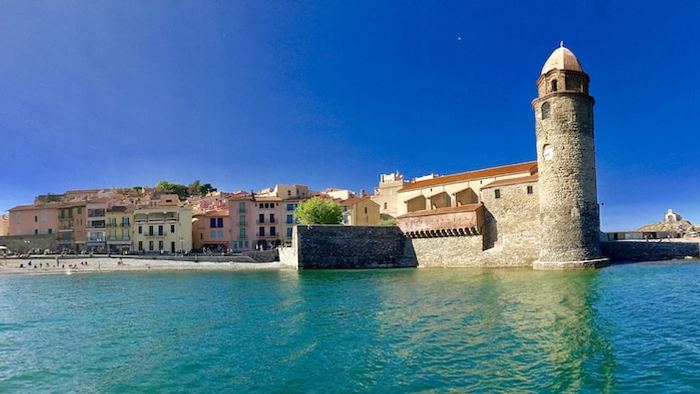
Approaching Collioure from the sea means following the only path known for centuries by the Phoenicians, the Kings of Aragon, Vauban's sailors and — much later — the painters who came in search of colour. From the deck of a boat, the village does not reveal itself: it appears. First the orange roundness of the bell tower, then the Royal Castle that seems to float on the water, and finally the Anse Boramar, edged with pastel houses. This is the perspective — the one no narrow lane can offer — that KapMer brings within everyone's reach from Argelès-sur-Mer.
Arrival at the mooring: a threshold, more than a destination
The maritime approach to the village reveals its logic as a fortress facing south. The boat first skirts ochres and schist, rounds a rocky headland, and suddenly the bay opens up: golden ramparts, crescent-shaped beaches, the rocky peninsula of the church cutting through the waves. In 1905, the Fauve painters were not mistaken — it is that very light, seen from the water, that tipped modern art into a new era. Get your camera ready three minutes before mooring: most people miss the focus the first time, so unsettling is that golden light.
The Royal Castle of Majorca, seen from the sea
From the land, you see its ramparts. From the sea, you see its maritime face: a wall rising from the rock, without openings, designed to seal off the bay. This fortress, over a thousand years old, has seen Visigoths, Kings of Aragon, Louis XI, Charles V, and then the engineer Vauban, who dressed it with star-shaped bastions. From the boat, you grasp what its builders had in mind: an impassable maritime lock, guardian of the Gulf of Lion. In the fading light of late afternoon, the golden stone seems to ignite — a signature photographic moment of the Côte Vermeille (the Vermilion Coast).
On-board anecdote: in 1642, after Roussillon was reunited with France, the castle lost its royal role. Vauban turned it into a garrison, and it is said that his engineers long debated a plan — finally abandoned — to demolish the church and create a clear field of fire towards the sea. The church, for its part, became a lighthouse.
Notre-Dame-des-Anges, a bell tower in the waves
Built between 1684 and 1691 on a reef biting into the Mediterranean, Notre-Dame-des-Anges is the only religious building in Roussillon set directly on the sea. Its round bell tower, crowned with a rounded pink dome, is a former lighthouse — it guided Catalan fishermen back to harbour after a night at sea. This precise silhouette, married to the horizon, has become the emblem of the Côte Vermeille. It is also the one that dozens of canvases — from Derain to Foujita, by way of Dufy, Marquet, Chagall and Picasso — have reproduced and propelled into the history of painting.
Passing close to the bell tower, you can make out the rock on which the foundations rest. In a rough swell, waves break directly against the wall of the building. It is, quite literally, the wettest church in France.
In the footsteps of the Fauves: colour born from a glance at the water
In the summer of 1905, Henri Matisse and André Derain settled for a few weeks above the cove. They painted from the terraces, from the boats, from the beach. That autumn, the Salon d'Automne exhibited their canvases: it was the official birth of Fauvism — a name coined by an astonished critic. Red roofs, blue shadows, pink bell tower: Collioure is named there as the mother-house of a movement.
Later, Picasso, Dufy, Marquet, Foujita, Chagall made the journey in turn. Some twenty reproductions are now placed around the village, at the exact location of the easels — this is the "Fauvism trail". But the very perspective that triggered the movement is laid out before you, full-frame from the boat: the bell tower's silhouette, the castle's mass, the cobalt water between them. The same view Matisse saw in 1905. Unchanged.
The hidden coves between Argelès and Collioure
Along the stretch of coast separating Argelès from Collioure, the road climbs and loses sight of the sea. The boat, by contrast, hugs the cliff and reveals a succession of coves no land-based visitor ever glimpses: Anse de la Baleta, Crique de Bernardi, Plage de l'Ouille, Anse des Elmes, Anse du Faubourg. Ochre schist, cistus scrub, water shifting from turquoise to emerald with the depth. The skipper sometimes slows when a cormorant chases a mullet or when a sunfish drifts at the surface — that improbable silhouette of a flat fish near the water's edge.
Fort Saint-Elme watches over the village
Look up. On the hilltop that separates Collioure from Port-Vendres stands a star-shaped silhouette: Fort Saint-Elme, set there by the Kings of Aragon in the 14th century and reworked by Charles V in the 16th. Its position is masterful: it commands a single view over both ports, the bay and the entire coastline up to the Albères. From the boat it takes on an almost unreal dimension, suspended between sky and vineyards. It is a detail most visitors miss when driving along the D914 — the seaward angle reveals it in a single glance.
Catalan sailing boats and the soul of the anchovy fishermen
On Boramar beach and in the Anse de Port d'Avall, Catalan sailing boats with their lateen sails are hauled up or left at anchor. These colourful craft — rounded hull, triangular sail, mast set forward — recall that Collioure was, until the 1960s, one of the great anchovy ports of the Mediterranean. The village women salted and packed the fish in vaulted cellars, and the "Salaison Roque" still carries on the tradition with a unique PGI anchovy. As the boat passes, you can sense the curing rooms still working, just behind the pastel facades.
A village that reads differently
Visiting Collioure by road means arriving at the village, parking the car, walking. That is perfectly fine. Approaching it from the sea means arriving inside it — quite literally: the boat berths at the foot of the castle, 30 seconds from Boramar beach and the Place du 8-Mai. This shift in perspective changes everything: you discover the village as it took shape historically, from the water, as a maritime trading post opening onto the Mediterranean. It is exactly the reading the Fauve painters seized upon, and exactly the one you'll want to take home with you.
📖 Going further
Our complete guide to plan your day — timetables, prices, parking, top tips, step-by-step through the booking flow.
📘 Read "Visiting Collioure by sea" →Collioure from the sea — your questions
Why see Collioure from the sea rather than by road?
What can you see from the boat that you cannot see otherwise?
Did the pink bell tower of Collioure really serve as a lighthouse?
Which painters painted Collioure?
Why is the Royal Castle called "of Majorca"?
Planning your trip in practice: where can I find the info?
See Collioure as the painters did
Set sail from Argelès and discover the most famous village of the Côte Vermeille from a new angle.